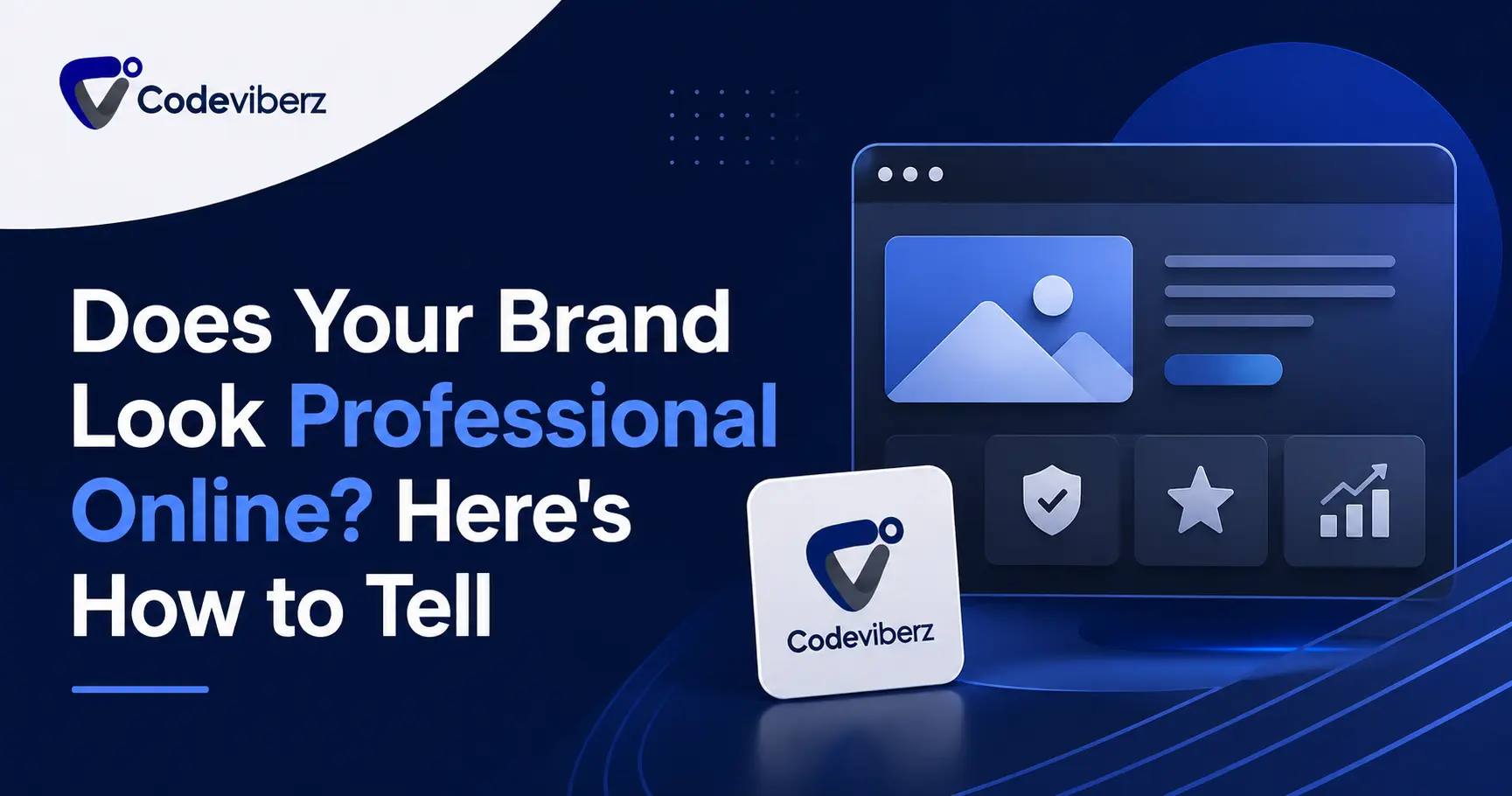
First impressions online happen in milliseconds, and most businesses are losing them without ever knowing it.
According to research published by Google, it takes users as little as 50 milliseconds to form an opinion about a website. That’s 0.05 seconds to convince a potential client your business is worth their time, or send them straight to a competitor. In a digital-first world, your online presence is your brand. If it does not look polished, credible, and intentional, it does not matter how good your product or service actually is.
This blog breaks down what it truly means to look professional online, the signals customers use to judge your brand before they ever contact you, the common mistakes that quietly damage trust, and how a strategic approach to your digital presence can change the outcome. Whether you are a service business, a trade, or a product company, this guide is built for business owners who want real answers, not jargon.
Codeviberz works with businesses across industries to close the gap between the brand they have and the brand they deserve. This post pulls from real project experience to give you a clear picture of what professionalism online actually looks like, and what it costs you when it falls short.
Why Your Digital Presence Is Your Brand
A decade ago, a business could rely on word-of-mouth and a basic website to stay competitive. That era is over. Today, the first thing most potential customers do after hearing about your business, from a referral, a social post, or a Google search, is look you up online. What they find shapes everything.
The Gap Between Perception and Reality
Most business owners believe their online presence is “good enough.” The hard truth is that good enough rarely converts. A website that was built years ago, a Google Business profile with outdated information, or a social media presence that has gone quiet all send the same message to prospective clients: this business is not paying attention.
- Outdated design erodes trust — visitors associate old aesthetics with old practices
- Inconsistent branding across platforms creates confusion and undermines credibility
- Slow or broken websites signal unreliability before a single word is read
- Sparse or low-quality content makes businesses appear smaller or less established than they are
- No reviews or social proof leaves visitors with nothing to validate their interest
The gap between how a business sees itself and how it appears online is often the single biggest barrier to growth.
What Customers Actually Look For
When a potential client lands on your website or finds your brand online, they are not reading every word, they are scanning for trust signals. These include visual quality, clear messaging, social proof, and structural clarity. Within seconds, they are making a judgment call: does this business look like it can deliver what it promises?
The 6 Visual and Structural Trust Signals That Matter

Professionalism online is not just about aesthetics. It is about communicating competence, reliability, and value through every element of your digital presence. Here are the six signals that carry the most weight.
1. Website Design Quality
Your website is not just a digital brochure, it is the hub of your entire digital presence. A poorly designed website undermines everything else you do online.
- Visual hierarchy — clear headings, logical layout, intentional use of whitespace
- Consistent brand identity — fonts, colours, and logo usage should be uniform across every page
- Professional imagery — stock photos signal inauthenticity; original photography builds trust
- Clear calls to action — visitors should always know what to do next
- Loading speed — Google’s Core Web Vitals directly connect page speed to user experience and search ranking
A business offering web design and web development as a core service understands that design is not decoration — it is strategy.
2. Mobile Responsiveness
Over 60% of all web traffic now comes from mobile devices, according to Statista. A website that breaks or becomes difficult to use on a phone immediately disqualifies a business in the mind of a mobile user. This is not optional, it is baseline.
- Text must be readable without zooming
- Buttons and links must be large enough to tap accurately
- Navigation must be simple and collapsible
- Images must scale without distortion
3. Content Clarity and Messaging
Visitors want to know three things instantly: what you do, who you do it for, and why you are the right choice. If your website’s messaging forces them to work to find these answers, most will not bother.
- Headline copy should state the value proposition immediately
- Service pages must be specific, not generic
- “About” content should build a narrative, not just list facts
- Every page should have one clear purpose
4. Social Proof and Credibility Markers
Reviews, testimonials, case studies, and client logos are not vanity, they are conversion tools. BrightLocal research shows that 98% of consumers read online reviews for local businesses, and the vast majority trust them as much as personal recommendations.
- Embed Google reviews prominently
- Feature client testimonials with full names and context
- Display logos of recognisable clients or partners
- Link to case studies that demonstrate real results
5. Search Visibility
A professionally designed website that no one can find is a missed opportunity. SEO is the mechanism that ensures your brand appears when people search for what you offer. Without it, even the most polished website generates no organic traffic.
- Keyword-optimised page titles and meta descriptions
- Structured content with logical heading hierarchy
- Local SEO signals for service-area businesses
- Quality backlinks from relevant sources
6. Consistency Across All Platforms
A business that looks professional on its website but inconsistent on Instagram, or that has a different tagline on LinkedIn than it does in Google search results, creates a fractured brand experience. Consistency is the foundation of trust.
- Social profiles should reflect the same tone, colours, and messaging as the website
- Google Business Profile should be fully completed and regularly updated
- Email signatures should match the brand identity
Common Mistakes That Make Brands Look Amateur Online
Knowing what a professional looks like is only half the battle. Understanding the mistakes that quietly damage brand perception is equally important, especially because most of these errors are invisible to the business owner but immediately obvious to a potential client.
Outdated or Cluttered Website Design
A website with mismatched fonts, competing colour palettes, or a layout that has not been updated in several years communicates neglect. Design trends evolve, and a site that looked modern five years ago may feel dated today.
- Overcrowded pages with too much text and no visual breathing room
- Multiple competing font styles with no design system
- Low-resolution images or stretched graphics
- Outdated copyright dates in the footer (a small detail that many visitors notice)
Vague or Generic Messaging
Quality service at affordable prices” is the most common and least convincing tagline on the internet. Messaging that could describe any business in any industry describes no business specifically, and fails to give any reason to choose you.
- Replace generic phrases with specific outcomes your clients can expect
- Name the type of client you work with and the problems you solve
- Use the language your clients actually use to describe their challenges
No Clear Path to Conversion
A website that educates but never guides a visitor toward action is a missed opportunity. Every page should have a logical next step, whether that is a form, a phone number, a booking link, or a case study that leads deeper into the funnel.
- Buried or hard-to-find contact information
- No visible calls to action above the fold
- Forms that are too long or too complicated
- No follow-up confirmation after a form is submitted
Real-World Example: Jones Outdoor Living
Sometimes the clearest way to understand what a professional online presence can do is to see it applied to a real business.
Jones Outdoor Living is a Vancouver-based landscape design and build company specialising in custom outdoor spaces, garden construction, and full backyard transformations. Their work is premium, carefully crafted, visually striking, and built to last. But their previous website did not reflect any of that.
The site lacked structural clarity, visual hierarchy, and the storytelling flow needed to showcase the quality of their craftsmanship. The information existed, but it was not presented in a way that communicated their process, their services, or their positioning as a high-end landscaping company. For a business whose value is almost entirely visual and experiential, this was a significant barrier.
Codeviberz delivered a complete website redesign and development solution focused on improving user experience, narrative flow, and conversion performance. The new design guides visitors through the brand’s philosophy, services, build process, and project portfolio in a structured and engaging sequence. Key improvements included a refined service and process architecture, enhanced portfolio presentation, improved content flow, and full mobile and performance optimisation.
The result is a premium, visually engaging website that genuinely reflects the quality of Jones Outdoor Living’s work, and helps attract the high-value clients they are built to serve.
The lesson here is not specific to landscaping. It applies to any service business where quality is hard to convey through words alone: the structure, narrative, and visual presentation of your website must match the standard of your actual work. When it does not, trust erodes before the conversation even starts.
Does Your Brand Pass the Professional Online Test?

Use this comparison to evaluate where your brand currently stands and what a stronger digital presence looks like in practice.
| Brand Signal | Unprofessional Presence | Professional Presence |
| Website Design | Cluttered, outdated, inconsistent fonts and colours | Clean, modern, consistent brand identity throughout |
| Mobile Experience | Difficult to navigate on phone, text too small | Fully responsive, fast-loading, easy to use on any device |
| Messaging Clarity | Vague taglines, generic service descriptions | Specific value proposition, clear outcomes for the right clients |
| Social Proof | No reviews, no testimonials, no case studies | Verified reviews, client testimonials, project portfolios |
| Search Visibility | Not appearing in relevant local or industry searches | Ranking for target keywords, optimised Google Business Profile |
| Platform Consistency | Different branding, tone, or messaging across channels | Unified brand identity across website, social, and Google |
| Calls to Action | No clear next step, buried contact information | Clear CTAs on every page, easy-to-find contact options |
If more than two of these columns describe your current situation, your digital presence is likely costing you clients, even if you cannot see it directly.
How Codeviberz Approaches Online Brand Professionalism
E-commerce solutions play an important role in building trust for product-based businesses. A well-structured online store with intuitive navigation, secure checkout experiences, clear product presentation, and optimized conversion paths helps customers feel confident throughout the buying journey.
Through E-commerce Solutions, Codeviberz helps brands create shopping experiences that strengthen credibility while supporting long-term revenue growth.
Codeviberz takes a systems-level approach to digital presence. Rather than solving one piece in isolation, the focus is on building a cohesive digital foundation that works as a whole.
This includes:
- Strategic website design and development — building sites that are visually strong, structurally sound, and built for conversion
- Search engine optimisation — ensuring the right audience can actually find the business online
- Digital marketing — creating demand and awareness beyond organic search
- E-commerce solutions — for product businesses that need a transactional layer built into their brand presence
- All-in-one digital growth — a comprehensive approach for businesses ready to scale their entire digital ecosystem
The goal is not to sell services. The goal is to close the gap between the quality of a business and how that quality is perceived online. For many businesses, that gap is significant — and closing it has a direct and measurable impact on enquiries, conversions, and long-term growth.
Businesses that want to explore what is possible can review the full range of digital services on offer and identify where the most immediate opportunities lie.
What Should a Good Digital Marketing Strategy Include?
A successful digital marketing strategy goes beyond generating traffic. It should combine a conversion-focused website, strong organic and local SEO, targeted paid campaigns, content aligned with user intent, and performance tracking that measures results across every channel.
Each element should support a specific business objective and work together as part of a connected growth system rather than isolated activities. Through All-in-One Digital Growth Solutions, Codeviberz brings these components together to create strategies designed to improve visibility, increase conversions, and support long-term business growth.
Frequently Asked Questions
How do I know if my website looks professional to visitors?
The most reliable way is to get outside feedback, from people unfamiliar with your business. Ask them to spend 10 seconds on your homepage and then describe what your business does, who it serves, and whether they would trust it with a purchasing decision. If their answers are vague or uncertain, your website is not communicating clearly. You can also use tools like Google PageSpeed Insights to assess technical performance, which is a key dimension of perceived professionalism.
Does a professional-looking website actually affect sales?
Yes, significantly. Research from Stanford University found that 75% of consumers judge a company’s credibility based on its website design. A poorly designed or outdated website creates doubt before a prospect has even read a word of your copy. On the other hand, a clean, well-structured website that communicates trust and competence shortens the sales cycle because prospects arrive already pre-qualified and confident.
How often should a business update or redesign its website?
Most businesses benefit from a meaningful design refresh every three to four years, and content updates should happen far more frequently, at least quarterly for service pages and regularly for blog or portfolio content. The clearest indicator that a redesign is needed is not age, but performance: if your website is generating traffic but not enquiries, or if it no longer reflects the quality of your current work, it is time to act.
What is the difference between looking professional and being found online?
These are two distinct but deeply connected challenges. Looking professional is about design, messaging, and brand consistency, what happens when someone lands on your digital presence. Being found online is an SEO problem, it determines whether anyone finds you in the first place. According to BrightEdge, organic search drives over 53% of all website traffic, which means a business that looks great but ranks poorly is invisible to the majority of its potential audience. Both elements must work together.
Can a small business compete with larger competitors online?
Absolutely, and in many cases, smaller businesses have a structural advantage online because they can be more specific, more human, and more responsive in their messaging. A large competitor with a generic website is often easier to outperform than businesses assume. The key is clarity: a small business that speaks directly to its ideal client, showcases real work, and builds genuine social proof will consistently outrank and out-convert a larger competitor with an unfocused digital presence.
Final Thoughts
Your online brand is not just a marketing asset, it is the first conversation you have with every potential client, often before you ever know they existed. In that conversation, design, clarity, speed, credibility, and consistency either build trust or quietly erode it.
The businesses that win online are not always the biggest or the most established. They are the ones whose digital presence accurately reflects the quality of what they actually deliver. When there is alignment between the standard of the work and the standard of the presentation, conversion becomes easier, client quality improves, and the business grows with less friction.
If there is any doubt about whether your brand currently passes that test, the most productive step is an honest, outside-in assessment of everything a prospective client would encounter, from a Google search result to a website homepage to a social media profile. Start there, identify the gaps, and address them systematically.
Ready to see what a stronger digital presence could look like for your business? Get in touch with the team at Codeviberz to start the conversation.
At Codeviberz, the focus is always on building strong digital foundations that help businesses grow consistently.